
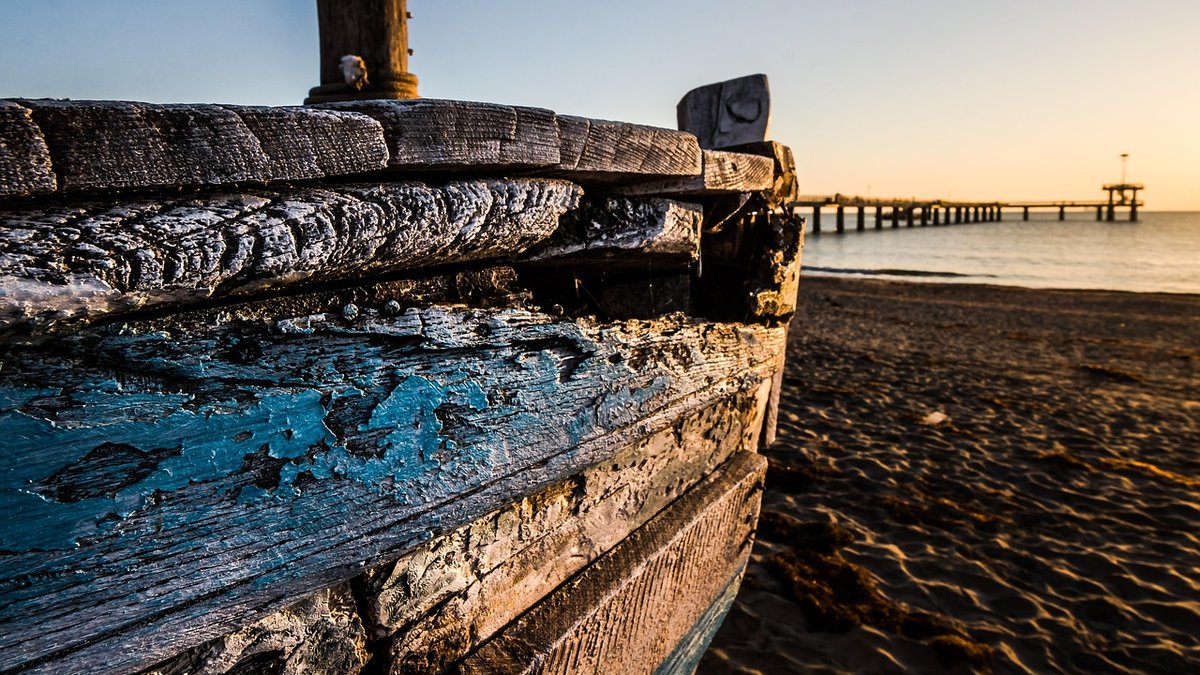
Walk any stretch of the British coast and you will notice how quickly the landscape changes character. A broad, cheerful bay gives way to a dark, narrow inlet with a shingle beach no bigger than a garden. These are the places the free traders prized. A smuggler needed four things from a landing site: deep water close inshore, a narrow mouth that could not be seen from the open sea, a steep path leading inland within minutes, and a farm, cellar or barn within easy carrying distance.
The coves of Cornwall and Pembrokeshire offered all four. So did the shingle spits of Romney Marsh, the gullies below the North York Moors, and the rocky inlets of the Berwickshire coast. Many were invisible from a revenue cutter standing even a mile offshore, and at certain states of the tide a boat could slip in, unload in twenty minutes and be gone before the alarm was raised.
The trade was driven by duty, not by wickedness. In the eighteenth century the tax on tea alone could exceed the value of the leaf itself, and gin, brandy, tobacco, silk, lace and playing cards all carried punishing rates. Meanwhile wool, tin and even pilchards went quietly the other way, particularly to France.
The trade peaked in the 1730s to 1770s. It was the 1784 Commutation Act, which slashed the duty on tea, that did more damage to smuggling than any fleet of cutters ever managed.
Communities developed an entire quiet language. A lantern hung in a church tower. A particular gate left open. A line of drying nets arranged in a certain way. A farmer's cart parked at an unusual hour. When the alarm came, it travelled faster by these means than any message could by road.
The routes inland matter just as much as the beaches. Look at any old map and you will find lanes that seem to go nowhere, connecting a cove to a moorland track rather than to a town. Packhorse paths across Dartmoor, Exmoor and the Welsh hills were used for legitimate trade for centuries and carried contraband after dark. Funerals were a particular favourite: a procession of mourners carrying a coffin attracted no comment, and a coffin could hold a surprising amount of brandy.
Be sceptical, though, about tunnels. Almost every old inn on the coast claims one leading to the shore. A handful are genuine; most are Victorian romance. The real architecture of smuggling is more ordinary and more interesting: blocked cellars, hidden lofts, false-backed cupboards, and salt-houses sited where nobody would think to look.
Every port of consequence had a customs house, and many survive as handsome Georgian buildings with a King's beam, a weighing room and a long counter for the paperwork of empire. Riding officers patrolled clifftop paths on horseback, revenue cutters lurked offshore, and dragoons could be called on when a landing turned into a battle.
The men were often outnumbered and frequently outwitted. Local juries were reluctant to convict, and a captured cargo might be liberated from a locked warehouse before morning. Punishments, when they came, were severe: heavy fines, transportation, and death for those who resisted with arms. The Victorian coastguard cottages that stand in lonely rows on so many clifftops were built partly as a deterrent, placing a watcher's family directly above the coves.
The folklore is where the coast really comes alive. Cornwall remembers Cruel Coppinger, a Danish wrecker said to have ridden inland on a stolen horse, and the gentler figure of John Carter, the "King of Prussia", who ran cargoes near Penzance while reportedly keeping his word to the poor. Kent and Sussex have darker tales of the Hawkhurst Gang, whose violence turned the public against them and ended, in the 1740s, at the gallows. Dorset recalls Isaac Gulliver, a smuggler who grew respectable and bought property with his profits.
Ghost stories cluster around the same spots: lantern lights on empty cliffs, hoofbeats on lanes with no riders, the smell of spirit in a cellars long drained. These are the community's version of history, and they carry an emotional truth even when the details wobble.
You do not need a guide to find this heritage. It is written into the landscape and the buildings.
Walk these coves at low tide, when the rocks show, and it is easy to imagine the quiet work that once happened here. Take a tide table, keep to footpaths, respect private land, and buy a coffee in the village. The communities that once kept their secrets are, on the whole, happy to tell you about them now.

Hi, my name is Anthony kuber. I am artist and fashion designer.
I love to travel and writing blogging.
Your email address will not be published. Required fields are marked *
Software Developer & Writer
Hey, I'm Diva, a developer and writer blending code and creativity. I'm driven by a deep curiosity and a relentless pursuit of excellence. Join me as I craft digital solutions and captivating stories.


